Summary
In this episode, Brad Onishi sits down with Rev. Alba Onofrio, the Executive Director of Soulforce and author of Spiritual Violence: Religious Phenomena That Defile the Faith. Rev. Alba brings nearly two decades of global activism across four continents to a critical conversation about the exact mechanisms religious systems use to inflict deep psychological and physical harm. Moving past vague concepts of religious trauma, she provides a clear framework that categorizes spiritual harm along a spectrum—ranging from everyday theological microaggressions to full-scale "spiritual terrorism." By defining spiritual terrorism as a sustained, systemic deployment of fear designed to subjugate entire communities, Rev. Alba exposes how weaponized theology acts as an active tool of control rather than an accidental byproduct of faith.
The discussion dives into how traditional religious imagery—such as framing God exclusively as a punishing "Father," "King," or "Judge"—subtly normalizes abusive and hierarchical dynamics in families, intimate relationships, and broader civic life. Rev. Alba and Brad unpack how white Christian supremacy shapes what the American context recognizes as violence, using the deployment of Romans 13 during the separation of immigrant families at the U.S. border as a chilling case study in theological terrorism. Crucially, the episode addresses Christianity's historical condemnation of "the flesh," explaining how policing the body strips individuals of their bodily autonomy and self-trust. Ultimately, Rev. Alba shares why she fiercely maintains her faith, arguing that naming these systemic abuses is not a rejection of spirituality, but the vital first step toward true healing, resistance, and collective liberation.
Meet The Guest
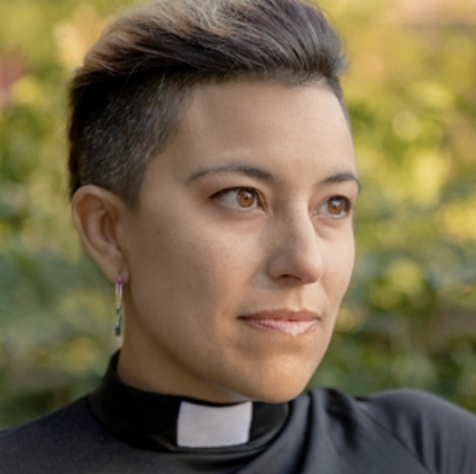
Rev. Alba Onofrio
Rev. Alba Onofrio is a public theologian and spiritual activist rooted in the Southern Appalachian mountains engaged in movement work for over 20 years. As Executive Director and Spiritual Strategist for Soulforce, an international LGBTQ+ social justice organization, Rev. Alba Onofrio has authored a series of theological resources on liberatory approaches to the Bible and uncovering the ideologies of white Christian Supremacy that have been translated into 7 languages. Also known by their public persona, Reverend Sex, they are a co-founding member of the Sexual Liberation Collective with a mission to eradicate shame and fear around bodies and sex in order to reclaim pleasure and desire as potent centers of sacred knowledge, healing, and spiritual praxis.
As a Queer, feminist Christian pastor and Latinx bruja troublemaker, their ministry works at the intersections of religion, gender and sexuality to heal the wounds of Spiritual Violence and weaponized religion around the globe, most passionately through the Spanish-language digital platform, Teología Sin Vergüenza, which they founded to amplify Queer feminist Latinx theologies throughout Abya Yala with an online following in over 47 countries. They also serve as a Global Presbyter for The Fellowship of Affirming Ministries (TFAM) focusing on accessible theological education for LGBTQ communities in Global South.
Transcript
Brad Onishi: Hey friends, if you haven't heard the news, we are entering the next chapter for Axis Mundi Media and Straight White American Jesus. This began as a podcast between two former ministers who are now religion scholars, but it's become something much bigger. Axis Mundi Media now reaches millions of listeners, educators, clergy, journalists, students, and organizers every year, and they're united by the fact that they're searching for analysis from experts they can't find anywhere else. The intersection of religion and politics now shapes nearly every major story in American public life, but the mainstream coverage usually misses the deeper structures and bigger issues. So we are taking our show and our network to a new place. The biggest expansion is the Axis Daily Brief, a short, detailed, rapid response about the most important religion and politics story from that day. We have a team of experts who won't just tell you what happened, but what it means and what to watch next. Monday through Friday, every morning in your inbox, ready for you to start your day with an understanding of what's happening with religion, politics, and the United States. We're not just trying to sustain Straight White American Jesus. We're building something bigger — a daily independent platform for understanding religion, democracy, and power. Because the forces shaping this moment are organized and well funded, and independent journalism has to be too. If you believe that kind of work should exist, then joining us is the next step.
Welcome to Straight White American Jesus. My name is Brad Onishi, co-host of the show, author of American Caesar, and founder of Axis Mundi Media, here today with a return guest, somebody who I think is amazing, and I'm so glad took the time to come back, and that is the Reverend Alba Onofrio. Thanks for coming back, Rev. Alba.
Rev. Alba Onofrio: Oh, I'm delighted to be here.
Brad: We're here because you've done something pretty amazing. You have a brand new book out, and it is something that dovetails on the podcast we've been working with you on, Teología Sin Vergüenza, which in English is now Shameless Theology. But the book is called Spiritual Violence: Religious Phenomena That Defile the Faith, and I'm really excited for people to hear this book, especially people who have been harmed by high-control religion and other forms of spiritual weaponization. This book does something that I think is going to be really helpful to a lot of folks. It gives them terminology, it defines them, and then it narrates and dramatizes how that looks in people's lives. You have so many personas, so many characters, so many vignettes of how these things actually work on bodies and in lives and in relationships. I think this is an obvious question, at least from where I sit. But you spent so many hours on this, so many hard-earned brain cells expelled on this project. What — why do we need this now? What made this something that was such a passion project for you to make sure got into the world?
Rev. Onofrio: Our people is what made it a passion project. You know, when you tell the same truth over and over again, and you feel like you can't get to enough people because there aren't enough hours in the day — that message for us was: it's not your fault, God doesn't actually hate you. There's an entire system of power behind the version of Christianity that you got, and you need to understand that this isn't the word of God directly from on high, just because your pastor said that he was the representation of God on earth or acted like it. And the book was a way to get that into written form that hopefully will reach seminary classrooms and people on trains going to work and mothers who are staying at home thinking about how they want to raise their children. So it's about getting this work that Soulforce has been doing for almost 30 years, and I've been doing for close to two decades, on paper in more organized, systematic ways, because what we have found over and over and over again is that if you don't have language to name what has happened to you, you feel like you're the only one, or it's very confined to your immediate space. And what we're trying to say is, this is not new, this is not isolated. Your story is unique to you, but there is a systematic way to understand how these structures and powers work, and by being able to name it, then you can name the harm that has happened to you alongside others of many varieties who can also name that harm. And once we can name it, then we can do a million things: we can organize, we can heal, we can strategize new ways of doing things, we can fight back, we can interrupt. There's so many possibilities, but it starts with being able to name and identify that thing which doesn't have a name, but yet causes so much worry and pain and hurt within us.
Brad: It seems to me that you're talking about something that is kind of the focus of chapter one in the book, and that's spiritual trauma, religious trauma. And I think this is a word that has come into the ether for some folks over the last five or ten years. I know for me it really has. I've done work to be a trauma-informed person who understands the ways that the religion I adhered to for my teenage years, my young adult years, has had a lasting impact on me, on my relationships, my sexuality, my partnership — like it's something that almost every day I have a moment where I'm like, oh yeah, there it is, there it is.
Rev. Onofrio: Yeah, yeah.
Brad: And I think there are others coming to the realization that religion and spiritual spaces, institutions, churches — these can be sources of trauma. What is spiritual trauma from your view?
Rev. Onofrio: Yeah, I think — and the book entirely is about spiritual violence, and it is ubiquitous. It happens across the spectrum, from microaggressions that happen every day all the way to the most extreme examples that you can possibly imagine of religious trauma and harm: from spiritual abuse, from physical sexual abuse, from full-scale weaponization of Christianity to condone things like chattel slavery and colonization. So we have that full spectrum, and what is true about spiritual trauma — coming at this as a theologian and not as a mental health professional — is that we need to understand that the implications of those experiences that we have in the name of God can have little impacts, like a little nick to our spirit because someone used our name against us based on Christian supremacist morality, or it can be catastrophic in our lives, it can end our lives, even. And so, spiritual trauma in particular is when the effects of those experiences of spiritual violence and abuse come to a level that they interrupt our ability to move through daily life in a full and abundant way, and it interrupts our understanding of how we can trust others or trust God, our feelings of being jaded, of there not being someone who loves us. And for certain communities that is much more prominent than in others, but it can happen to anyone, really.
Brad: Is spiritual violence particularly linked to white Christian supremacy in the context of North America, the United States, and so on? How do you see the relationship between spiritual violence, as you just talked about it, and white Christian supremacy?
Rev. Onofrio: They are so connected. Just like culture is place-specific, so is spiritual violence. So, this book was originally supposed to be just the English translation of a transnational project amongst three Latina authors, scholars, theologians — a Roman Catholic lesbian in Colombia, a straight cisgender woman in Costa Rica who was both a theologian and a psychologist, and me, a Latina queer pastor. And the idea originally was just to translate the book and put it out in the world in English, and I, over the course of the five years it took to write this book, wound up just having to scrap the whole content that wasn't the body exercise, the somatic practices, because the context in this country is entirely unique. The colonizers were different than the colonizers of Latin America. Our understanding about secular society is different than it was in Latin America. Our points of reference, how we understand politics to work, the feudal lord system that was so prevalent throughout Latin America during the generation of colonization and the ones after, versus here, where we have a different structure of genocide and land theft, as opposed to the integration and the betterment of dark-skinned societies in Latin America. So literally everything is different. So the connection between place and this concept, this book, is entirely particular to the US in this particular moment, and looking back on history of this particular place. So it's still rooted in all of the stories and narratives in the Christian tradition, which — you know, the sword and the colonizer came along with the Bible and the priest everywhere — so that still remains the same, but we had different narratives of our origin stories and folks coming here for religious freedom that was not centered on Catholicism. So all that to say, the relationship between spiritual violence and how that looks — particularly in this political moment in this particular nation — is very critical to getting at the thing that we're trying to talk about, which is understanding people's lived experiences with faith, and the things that we have in common, the things that maybe we don't know about other people's faith. Putting that together in place and time is critical to making it relevant to this place, which is why it took so long to write the book.
Brad: This might feel like a tangent, but I don't think it is. You know, when I think of folks who are doing just essential and singular work in spaces that are not often overlapping — you work with Latine theology and church spaces, you're also in queer theology and church spaces, you're also unabashedly feminist in your approach to theology and church, occupying that space and doing so in such robust conversation with folks across the Americas, but also across the world. You travel more than I think anyone I know. Like, how did all of those experiences, those conversations, those relationships, those perspectives help you come back to a place here in the United States where you have a certain view of how religion and white supremacy work together? I mean, I just think of you as somebody who has such a unique perspective on all of this. You are born and raised in the United States, but your perspective is one that's been shaped globally. How do you think that's affected how you see these phenomena?
Rev. Onofrio: It changes everything. I mean, I grew up in western North Carolina and Appalachia, and I'm really proud of that. But even that — growing up as a great-granddaughter of a coal miner who raised me — it forms these understandings and these narratives. And then once I started opening my horizon to understand that there was a thing called the South, and once I understood there was this whole mythology around the US, once I got out of the US — and then the more I go around the world, I think it maybe was East Africa that really helped me. Being deep in community for years and years with folks was what helped me really put ten toes down to the belief that the experiences and the expressions may be a little bit different, but the harm and the ideology behind the harm is the exact same. And it may have a different cultural shape and flavor. The consequences of being queer or trans may look different culturally, depending on what the denomination or what the culture of that particular place is, but I feel really solid in saying spiritual violence is a thing, it has these characteristics, it does these kinds of things to our spirit. It impacts our lives, even if the wounds are invisible, just as incredibly. It just takes up so much space in our psyches, even if we have educated ourselves out of believing whatever the things were. I often say it is often my experience that there are still little voices in our head — whether it's from our very religious grandmother, or that pastor that we had growing up, or just being a part of a culture that attributes everything good and bad to God and God's plan and God's timing. Even when we are very highly educated, we still have those nagging voices, most of us, in the back of our minds — that when something bad happens, we think: did I do something, or is God mad at me, or is this because I didn't do — or did — something. And those little voices in the back of our psyches that we tuck away into corners still need attending to, even if we are full-blown atheists with PhDs and understand how many intellectual things work. So that's the thing that makes that global perspective — it just makes me more sure and more clear. Because wherever Christianity has been used to colonize, to enslave, to abuse, I find the same stories, the same hurts, the same wounds. And on the other side, some of the same healing balm to put on those wounds, some of the same strategies to get out of those systems of self-harm around the internal bullying that so many of us do to ourselves. So that's the hopeful part, and that's what makes me very clear — four continents later, I'm really sure about what's in the book.
Brad: You know, one thing that happens when we leave home is when we come back, we often see it differently. And I know for me, when I've done that, I've had these moments of like, oh, that's how that works, like I grew up in that, or I was saturated in this, and now that I've stepped away and I see it through different eyes, I can see the mechanics. And I'm wondering — one of the things that the book does is try to show us how spiritual violence becomes normalized, and it's just sort of part of our social environment.
Rev. Onofrio: Yeah.
Brad: How do you see that happening in the United States? And are there stories from the book — this is a book that's so filled with stories and characters and vignettes — are there other folks that you might want to highlight, whose lives and experiences kind of exemplify the normalization of those spiritually violent practices?
Rev. Onofrio: You know, one of the things that concerns me most is how our vision of who God is, and the relationship that is appropriate for humans to have with God, gets transposed and connected and normalized around how we anticipate human relationships to be and what we find acceptable within that. I think that's one of my biggest concerns, just as a human, as a mother, as a theologian, as a pastor, because the Bible and Christian tradition are replete with images of God. We have biblical images — so many biblical images of God as laboring mother, as midwife, as mama bear, as mother hen. We have so many options for how to see God, and yet for most of us we have never heard anything other than God as He. And we continue to use analogies like Father and King, and we still sing the songs. You know, I'm appalled every Christmas because we're still singing these King songs and these monarch songs, and yet we live in a country that supposedly was created in response to rejecting that kind of monarchy system. So it's just — we don't always pay attention to what we're singing, what we're teaching our children, what we're clapping along to on the radio or in church. So that's a problem, because for example, there are words that we could translate from the Bible that do not mean fear, but yet we continue to say, you know, "I'm a God-fearing person," or that it's an appropriate relationship to fear and respect God. And that is a theological choice that we have been given around this understanding that God in this male figure is someone that we should fear, and that that's acceptable — that God loves us, but God also punishes us, or God tests us, and God is a jealous God. We have all of these analogies that we choose to use around who God is and how God behaves, and whose responsibility it is not to offend God, not to dishonor God, not to make God mad. And so when we see that on the other side, we have many stories — and all of the stories in the book are true. Sometimes they're compiled stories of more than one person, and sometimes they're literal first-person narratives that the folks wrote themselves and I just adjusted for the book. But we have this understanding that being scared of someone that you love, or is supposed to love you, is acceptable. Someone punishing you who has power over you is acceptable. Someone who has uncontrollable feelings of rage or anger, or forgiveness that happens only after you are completely submissive and beg for forgiveness — even if the one who has more power is the one who is causing the harm. So those kinds of things are what make it seem so normal for us to fear the pastor in our church, or to avoid speaking up against something he said on Sunday, or something that our Sunday school teacher said. There's a reason why our community — las sinvergüenzas, or the shameless ones — have often been labeled at some point in their life as the black sheep, as the one who wouldn't shut up or asked the question that nobody wanted to ask, or, you know, asked the terrible questions in Sunday school when they were kids that got them kicked out. I think there's something really important to say: when we're talking about domestic violence, when we're talking about relationships of love and who we seek in partnership, there are these narratives that come from our faith that say this is how it's okay to love or not love, this is how it's okay to be harmed. And yet that's done by somebody who claims that they love you, and that's acceptable — that's actually your responsibility not to get the scorn or the ire of someone in more power than you. And that doesn't even speak to patriarchy. We're not even talking about these huge concepts like patriarchy or white supremacy — even just in those intimate ways, it impacts so many of our lives.
Brad: As you heard me say at the top, friends, we are expanding Axis Mundi Media and SWAJ. This is about more than adding shows or episodes — we're building a daily independent media platform dedicated to understanding how religion shapes power in the United States. We believe democracy depends on religious literacy. We believe authoritarianism thrives when history is forgotten. We believe independent media matters now more than ever. One change you'll notice right away is that starting June 12, the weekly roundup will be live every Friday at 1:30 Eastern. And on Tuesdays, starting June 16, I'll be live at 1:30 Eastern with Matthew D. Taylor, analyzing all the headlines surrounding religion and politics in the United States and beyond. We believe audiences like you deserve analysis that is rigorous, historically grounded, and unafraid to name what is happening in this country. So join us — a growing community committed to understanding and resisting authoritarian religion in this country.
There's this sense of residue in my body from those years — a sense of fear, and a sense of, like, what would happen if I let myself follow my desires and my intuition and my instinct, because those things are supposed to be regulated. And if I let those go, I'll be out of control, and then I'll be in real big trouble. And I think about that often. But when I hear you speak, I think about what you're saying — which is that particularly white Christian supremacy and spiritual violence are particularly harmful and aimed at women, queer folks, and those who are not white in the United States. And I'm just wondering, how do you see that? And if there are stories from the book, or a certain person's account that you'd want to highlight, of how that targeting has a deeply traumatic effect on people?
Rev. Onofrio: Yeah — so many, it's hard to even choose just one. And I would correct what you're saying just a little bit by saying even people who fit exactly in the core of the bullseye of what white Christian supremacy names as ideal, because you are still supposed to fit into the box. I think a significant problem that we're having in the US and around the world is masculinity that has to be so controlled and confined to these tiny little boxes that even men — and especially white men in this moment — don't have space to even connect to their own humanity, because they are so restricted in how they're allowed to express love and desire and pleasure and emotion and connection. And so I think white Christian supremacy and spiritual violence deadens our soul in different ways. So for white folks, being a part of a legacy and tradition that says that certain people are not fully human and not worthy of dignity and not worthy of survival, much less abundance — that also eats away at the souls of those who have to live into that legacy rather than interrupt it. So I really do think that it's universally, personally harmful.
But I will tell maybe the story of the young couple who came to the US from El Salvador, who were there with the intention of making money and eventually going home, or to wait out whatever was happening in that moment — particularly in El Salvador, it was about gang violence amongst particularly poor and working-class places. And seeing what happens when folks come to the US and send money home: kids all of a sudden are able to go to school because they have school books and uniforms — lots of things in places where public education is not a given, where you still have to pay for things like uniforms and books and transport. So that hope of a young couple coming at different times, but being caught at the border — and particularly in this moment, right, where we have this mother, this young mother with two children under five, and then being separated at the border. This is — you can just Google it, it's not even a unique story. It should be outrageous, but it's not even a unique story. In this case, a father who was here first but undocumented can't go claim his children that have been separated from their mother. The mother gets deported, the two children are left in what we know — the cages with those aluminum blankets on cement floors — forever and ever. And then they get put into the unaccompanied minor category, and they get put through the foster care system, and again the adoption system, if they're lucky. But there was intentionally — and now we have evidence of this — in the first Trump administration, an intention to disconnect the files of children from their parents, so that once they get into the system, there is no way to retrace them back to who they came with. There's no intention to ever put them back with their families. And when asked about this, when there was that height of public outrage when it first started happening, we had the Attorney General claiming Romans — that God has put this administration in power, and therefore it is the administration's duty to uphold law and order. As if a mother escaping gang violence in her country with her two children under five were somehow a criminal, rather than someone who gets a speeding ticket. It's a civil concern rather than a legal one, but yet over the course of our administrations we've turned it into a felony, so that it is a criminal offense. So it's this morality that says law and order has to be maintained because God said there had to be law and order — not any kind of understanding or recognition of what laws mean and how easily they can change, and how borders cross people rather than people crossing borders. So there's this understanding: if it's legal, then it is right, and it is just, and God ordained it.
And then on the other side, you have things that everybody knows — that there's not a human alive that I believe thinks it's a good idea to take a toddler away from its mother and away from its parents forever because they were trying to give that child a better life. Even folks like this family, who absolutely 100% should qualify for asylum in the United States, but because they're poor, because they came over on foot as opposed to in some other highly legally curated way, and because there's just so much violence in the world — in this case in El Salvador, directly connected with the US government and what we caused there. And so we have these consequences of our own actions as a nation, and yet what is the narrative that you can possibly give to justify separating a small child from its mother forever? And it has to be based on this idea of — in this case, law and order, but also on the underlying idea that there are certain people who are just not quite good enough to be human. And we have to assign labels like "criminal" to them in order for it to even be fathomable in most of our minds. So that's one of the examples that I would say is actually spiritual terrorism, because this family has the intersection of being poor, being undocumented, being a woman, being a mother. And so you have all these things coming together at once, and that kind of constant terror coming from multiple directions is something I would actually call spiritual terrorism, rather than just spiritual violence.
Brad: So in spiritual violence, we might have what we might call microaggressions or practices in everyday life that are hurtful, that open wounds. And yet in spiritual terrorism, we have the goal of keeping your victim in perpetual fear — is that why this reaches that level to you?
Rev. Onofrio: Yeah. And just the same as the terrorist language we already use in the US — which is a highly gendered and a highly racialized term, and we do that intentionally, because it's almost always used for our Black and brown communities and almost never used for the white terrorism that is actually much more terrorist-like in our country. And so we use that terrorist language in particular when the aim is beyond just the individual person. So that person, that family story getting out and it being repeated many times over — that was in part about their own specific disenfranchisement, but more importantly it was trying to send a message: the worst thing that you can possibly imagine happening — something worse than death for most of us, for most of us who are parents. There is nothing more terrorizing, nothing worse that I can think of, than my children being pulled away from me. And so to use that and say, "We're not even sorry — this is what's going to happen to anyone who tries to do this thing, anyone who tries to escape violence or corruption or fear in their own country and crosses the border — we are going to take your children away from you." So one family was one example, but the point wasn't just that one family — it's to send a message to an entire group of people. And I think the Black community in this country has been experiencing this for as long as there have been Black people on the soil of what is now called these here United States. So it's not a new strategy. But there's violence that happens — just like school shootings — where the intent is to cause harm, but the harm that is intended is much farther than just what's happening immediately in that moment. There is a specific intent that comes from law enforcement, that comes from communities, that comes from churches, that comes from families, and that intent is to say: you are not just unsavory. It's not just that we want to avoid you, it's that you are a threat and you are evil, and therefore you must be silenced, taken out, destroyed. And that's the difference between what we feel like when we are victims of spiritual terrorism versus just spiritual violence that happens all the time, all around us, to different and varying extents.
Brad: Well, and maybe that's — and I'm happy for you to correct me here. You know, I'm wondering about spiritual violence as something that does deaden the soul of even the white folks who are recruited into white supremacy and white Christian supremacy.
Rev. Onofrio: Yes.
Brad: I'm thinking — I'm a mixed race man, but I'm a cis man, I'm a straight man. When I was in evangelical culture, youth group culture, there was this assumption that I was, you know, pretty good at fitting in with the demographic. I liked to play sports, I liked to play basketball, I liked to go on hikes, or whatever they thought men were supposed to be. There were like good indications that I was one of the dudes. And the entire time I felt awful about myself. And I would often try to like sneak away at summer camp to go read theology books, and hope the other guys were like, "Oh, this wimp doesn't want to play the game or play football with us." And the point, though, is there's definitely spiritual violence in that context for someone like me. I don't know that there's spiritual terrorism for someone like me in the way you're talking about others. Is that a fair distinction, or do I have that kind of maybe misguided?
Rev. Onofrio: I think you have that completely right. I think you have that completely right. And I want to make this one caveat, because while I think that is true in terms of the government and in terms of the structure of US society, I want to really be clear that there are people who live in communities that are so centered on religion and so insular and isolated that there actually isn't that same kind of access to privilege outside of it. So I'm talking about people who have lived through cults or cult-like, highly controlled religious spaces, because I've talked to so many people who grew up in communities where — we talk a little bit about this in the book — where the understanding of Paul to the church of Corinth was that you were not to involve any outside authority under any circumstances, no matter what the harm that was happening within the community. And that's still something that most communities follow, even more mainstream denominations. You try to keep it quiet and keep it in-house. So what that means for folks — particularly children or young people who grew up in those kinds of spaces — it means that the idea of going to the police, or even that there are mental health professionals out there that aren't Christian, don't even exist in the imaginary. Like it's not even conceivable that that could be real.
And so, if you take, for example, a young woman who is experiencing some sort of sexual abuse or harassment within a community that is highly religious, and her mother and father are in the same church — and they don't have to be cults in like the Branch Davidian compound kind of way. It can be a rural church. It can be an immigrant church where everybody here speaks the same language, and we know the pastor because they helped get us over here, and we owe them because they took care of us or helped us connect to a job. There's all these infrastructures where the idea that we can just leave isn't even real. So in those kinds of structures, if you think about a young woman who's still under her parents' roof, or a queer person who's experiencing sexual violence or harassment or bullying by the pastor, or kind of economic exploitation where you're working many hours a week for free, or close to no pay, as a musician, as an associate minister — fill in the blank. It might look from the outside like you're a privileged little white girl, or you're a white boy, or whatever, but within the context of that community, there is no escape. Because when you go to school, you're still in a church school with people that go to your church. When you go to church, you have the aggressor, the person who is victimizing you. When you go home, you have people who are completely bought into that religious practice, to that faith leader. And so those are like micro worlds where the terrorism of — "I can't ever be myself, I can't ever escape" — because there is this constant understanding: my family thinks that the pastor is a prophet, is a man of God. There is no school outside of my church community, or all of my hobbies, or if I'm homeschooled — my goodness, there's such a huge homeschool movement. How many of those folks — so even in that world, I think as adults, once we're not in that anymore, we can see all the things that existed, but when you're in that world, especially if you have such restricted access to secular spaces — some of us didn't get to listen to secular music, much less have social media or whatever — you just don't know. So there could be terror that happens in that microcosm of a family space or a church community space.
But what I'm talking about nationally and internationally are kind of these structures — for example, right now being a trans woman and a working-class person. You may have many more encounters with police than you would if you had lots of money. And you could be a famous trans person who has lots of access to privilege and spaces that love and adore you. The level of harm is different, the level of risk and fear is different. But the more of those non-center-of-the-ideal markers you have that don't align — like you were talking about in the youth group — the more likely you are to experience spiritual terrorism.
Brad: Yeah, that makes a lot of sense. And I mean, I think my next question was going to be about the ways that certain theologies foster abusive practices and abusive cultures in churches and other places. And one of the things that Soulforce does so well is talk about how people use the Bible as a weapon. You've created resources that are like Bible self-defense classes, right?
Rev. Onofrio: Yep, yeah.
Brad: And I think a lot of people listening are going to just understand this intuitively, but it may be worth spelling it out a little bit about the ways that weaponized theologies are really what lead to abusive cultures within religious spaces. And I'm just wondering if you can flesh out how those things work for us.
Rev. Onofrio: Well, there are so many examples. But let's take the one that you were talking about, which is — I think there's just a huge world you could spend the rest of our lives exploring — and that's the body. We, as Christians, have a faith that says that there was a divinity who incarnated into the flesh and lived as a full human — wholly human and wholly divine — and yet so many of our communities of faith, our theologies, our Bible stories, are naming this thing called the flesh — i.e., our bodies — and telling us to kill every part of our response system that tells us what to fear, what is not okay, when we're not happy, when we're — even things like when you're hungry, when you're thirsty. Everything that happens with the body is a gateway to sin of some sort, a gateway to indulgence, a gateway to gluttony, a gateway to sexual sin. My goodness, we could spend lifetimes just on sexual sin. But it's all these theologies that condemn the body as a site of sin and a site to be wary of, to not listen to, to silence, to control. And that kind of theology then makes it so that we no longer trust what we know internally. We don't listen to ourselves when we feel fear, or when we feel hesitant, or when something is just a no because it's not the right thing for us, or when something is a yes with our whole souls. One of the gifts I think of the LGBT community is that so many of us have had the experience where, in spite of everything we've been taught, the yes of love, of desire, is so strong that we actually lean into what it could be like to be a queer person, even in spite of all that. I think most straight people don't have that same kind of experience. And that's something that so many folks suffer from. So when you name the body as a site of sin and suspicion, what that means is you're taking the internal narratives, the internal systems of regulation and understanding and control, and you're exporting that to somebody on the outside. And as soon as you start giving control over what's right and what's wrong for you — and your body and your soul and your relationship with God — to someone else, then you become able to be controlled not just by pastors and churches and theologies, but by society writ large. Because we're always scared of being found out that we're not good enough, or we're always fearful that we've listened to our body and therefore we have done something terrible, rather than a theology that centers the flesh as something of deep concern for God, because God chose to incarnate as human, and therefore the human body, the human experience is critically important to this thing we call faith, and this thing we call worship. And that work is such lifelong work. If you've been instilled from birth or from childhood with the idea that you shouldn't listen to your body, you shouldn't trust your body, you shouldn't develop your intuition, et cetera, et cetera.
Brad: I used to teach this really dumb class at UCSB called Judaism, Islam, and Christianity — and it's not dumb because I think any of those religious traditions are dumb, it's dumb because it was a summer class and in six weeks I had to teach Judaism, Christianity, and Islam. So we would do like two weeks on Judaism, two weeks on Christianity — and it was really dumb. But one of the things that the students and I always talked about was how Christianity is so weird because it's the one Abrahamic religion where the deity literally became human.
Rev. Onofrio: Yes.
Brad: And Christian theology from the apostolic era to the Nicene Creed is adamant — nope, Jesus had a body, fully human, fully God — and you're like, okay, they were really into this. They were not going to let Jesus off the hook. He was not a ghost, he was not an avatar, he was not like a demigod — this was a human, carnal. And I like — with the students, we'd always say, "the incarnation" — and a lot of the students would be like, "I'm a Spanish speaker, carne, that's meat." And I would be like, "Yeah, yeah, like — God was meat." And yet Christianity, at least in many of the ways that the students had experienced it, was the most vehemently opposed to living in your body, to allowing your body to be in any way, you know, expressive, desirous,
Rev. Onofrio: Yes. Amorous, and so on. So anyway, just wanted to throw that in.
Brad: White Christian supremacy, right?
Rev. Onofrio: That is saying — that is taking a religion and a faith that has everything to do with flesh, with the human experience, with life right now on this earth, right now with justice, right now with equality and equity right now — and somehow working through all of these acrobatics to get to a place where the body is not important, and we should just be focused on getting our treasures in heaven, and we should not be listening to our body because it's evil and bad and it's ruled by Satan, and maybe demon-possessed at any given moment, and we should submit ourselves to even just the practices. When I think about what has been lauded — the withholding of basic needs like food and water — it's like these are core religious, faithful practices to help us get closer to God. When we hear stories about Jesus in the Bible, who was supposedly God, he's forever eating and drinking and hanging out and talking and going to the water. And this doesn't make sense when we can take a step back, and it feels silly. And most folks I hear that critique the Bible or criticize Christianity are like, "That's just so stupid." And it's like, okay, valid that you now can see those disparities and that hypocrisy within the practice. But can we acknowledge that when we are deep in that belief — or even when it has been ingrained in us through society about what is right and what is wrong, because all the things that we understand in this country as right and wrong are based in white Christian supremacy — some of them could be argued absolutely as universal, but others are not. So in that way, that still impacts us in a very real and concrete way. Not just that it's absurd — which it absolutely is absurd — that this religion hates the body or needs to control it, or gives the control outside of ourselves to other faith leaders or denominations or books or whatever. But it also is the site of harm. And so because we know how to recognize physical harm, and even now more and more emotional harm, I think that we miss the harm that happens to the spirit.
So just because they happen together — just because the religious abuse that happens — for example, if a faith leader sexually abuses a congregant, even though we can talk about the sexual violence and that's super important, if we don't also talk about the harm to the spirit, what happens to the person who — out of just the basic setup of how churches work — comes to a faith leader open, vulnerable, honest, trusting, and that faith leader takes advantage of that, not just as a random person who takes advantage of someone, but as the person who was carrying the full weight and mantle of God, the creator, the most omniscient, omnipresent, powerful being in the entire universe. If we don't name that the power dynamic in that relationship, and what is being used against the person, is a different level of violence than if it was just a random stranger or somebody that you met at a nightclub — then we are not getting at the wounds that are there far beyond what happens to the body or even the psyche, even the mental health work. There is spirit work that needs to happen there, around repair and understanding what allowed us to have that relationship and what the formation of churches are to begin with, that allows that to be our belief that that is the man of God, that is the prophet, that is the person who speaks for God on this plane. Until we get at that, we can't fully address the wounds that we carry long after the physical ones have healed.
Brad: We couldn't be more excited about the future of SWAJ and Axis Mundi. Couldn't be more excited about our growing community and the people who contribute to it. But we need your help in order to deliver it. Your support will help us expand our live programming, build a sustainable video operation, hire the producers and editors we need, and ensure that the Daily Brief happens every day, every week. Every dollar that comes into us supports independent scholars and reporters who are creating educational resources and expanding community spaces and live offerings. In order to keep our work independent from corporate media pressures and any other influence, we are moving our subscription over to Substack. If you're already a subscriber, don't worry — we've reached out. We have all the ways to help you get over there, and you'll have time to make the switch. But if you're not yet a member, think about joining today in order to support our expansion and our efforts here at Axis Mundi. You can also become a donor. There's a link in the show notes for philanthropic, tax-free donations. We are looking for founding donors to make the next chapter of our network and our show possible.
We are just about out of time. I want to ask you one more question, if you have a minute. But before that, tell us where we can find the book, and other places that folks might link up with your work. I know there are people using this book in classes, in church groups, and other places. Spiritual Violence: Religious Phenomena That Defile the Faith — where can people link up with everything that's happening here?
Rev. Onofrio: Yes, well, you can find us at soulforce.org on all social media. You can find a link to the book on our website, soulforce.org. You can find me, @Reverend_Sex, on social media. The book has global distribution, so anywhere you would buy books — though we love for folks to support either their local bookstores or buy it directly from the press, which is Lulu Press. You can find the links to those on the website as well. There are ebooks, there's an audiobook coming, so it's in many, many formats. The ebook is much more economically priced — I think the book itself is twenty dollars, the ebook is like five. We're just trying to get it in as many hands. And if there are educators who want to use it in their classrooms and their curriculum, we encourage them to reach out to us, because we can do bulk discount, we can do educator discounts, and things like that.
Brad: And, as always, catch Reverend Alba on Shameless Theology and Love Letters from Reverend Sex. The first one appears on Mondays, the next one — Love Letters — appears on Wednesdays. And there's just not much out there, folks, in the way of people who are offering these perspectives from a queer, feminist, and Latina perspective. And I can say that you might be familiar with deconstruction resources, you might have deconstruction people on Instagram you love to hear from, but what I've learned from Reverend Alba is something that is unique — and that's a perspective that comes from a certain intentional space and offers something I think no one else does. So, check it out. All right, subscribers, I'm going to ask Rev. Alba one more question. If you're not a subscriber, you should do that now so you can continue this conversation and everything else we do here.